The file on
World War I
1914-1918
Between 1914 and 1918, a quarrel in the Balkans grew into the first truly global industrial war. Somewhere between fifteen and twenty-two million people died, four empires fell, and the modern world was born. In this hour-long episode of The Wars Of History Podcast, Mike tells the complete story of the First World War in a calm, conversational deep dive that gives every side its due: Britain, France, Germany, Austria-Hungary, Russia, the Ottoman Empire, Italy, Serbia and the United States, plus the colonial soldiers and laborers from India, Africa, China and Indochina who are too often forgotten.
We begin with Europe in 1914: royal cousins, the alliance system, the dreadnought race, empires, nationalism and the Balkan powder keg. Then the assassination of Archduke Franz Ferdinand in Sarajevo, the July Crisis and Germany's "blank cheque," the Schlieffen Plan, the invasion of Belgium, the "scrap of paper," and Sir Edward Grey's famous line about the lamps going out across Europe.
Next, 1914 and 1915: Louvain, the First Battle of the Marne and the Paris taxis, Tannenberg, Serbia's early victories, the race to the sea, the Christmas Truce, and Laurence Binyon's "For the Fallen." We look at life in the trenches, gas at Ypres (told without graphic detail), John McCrae's "In Flanders Fields," Khudadad Khan and the Indian Army, the tirailleurs, and the Chinese Labour Corps.
Then the global war: Gallipoli seen by Anzacs and Turks, Mustafa Kemal, the Armenian Genocide, the Arab Revolt and Lawrence of Arabia, Sykes-Picot and the Balfour Declaration, Kut and Mesopotamia, East Africa and its porters, the Italian front, Serbia's winter retreat, and Flora Sandes.
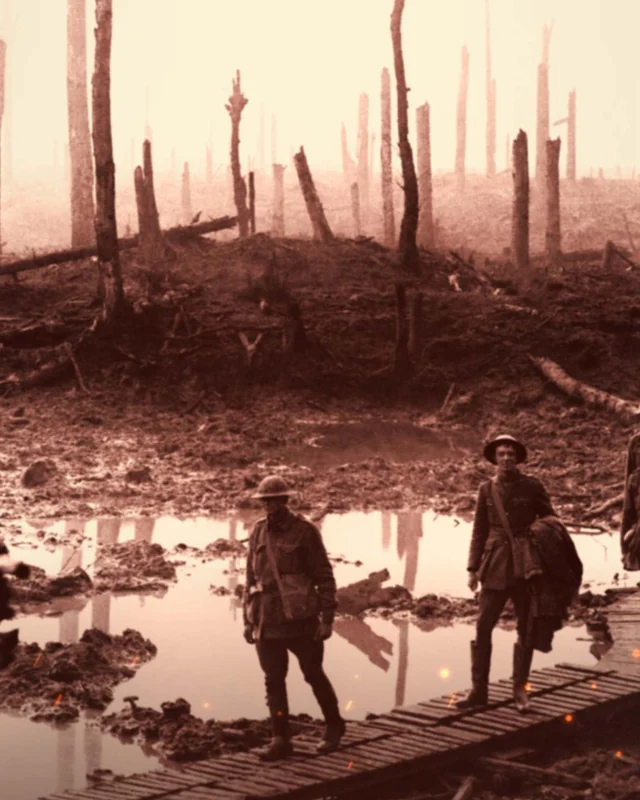
After that comes 1916: Verdun and "They shall not pass," the first day of the Somme and the Pals Battalions, the first tanks, the Brusilov Offensive, Jutland, the blockade and Germany's turnip winter, total war, women in munitions factories, and Edith Cavell's "patriotism is not enough."
Then 1917: the Lusitania, unrestricted U-boat warfare, the Zimmermann Telegram, Woodrow Wilson's "safe for democracy," the Russian Revolution and Lenin, the French army mutinies, Vimy Ridge, Passchendaele, Caporetto, and Wilfred Owen's "Anthem for Doomed Youth."
Finally, 1918 and the peace: the German Spring Offensive, Haig's "backs to the wall," Amiens and the Hundred Days, the Harlem Hellfighters, the armistice at the eleventh hour, the Spanish flu, the Treaty of Versailles, the fall of four empires, the League of Nations and the broken promise of self-determination. We close with eight lessons from World War I.